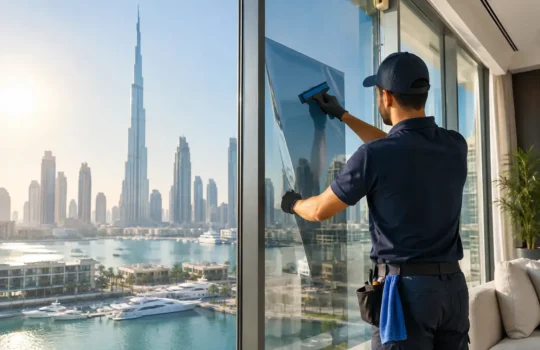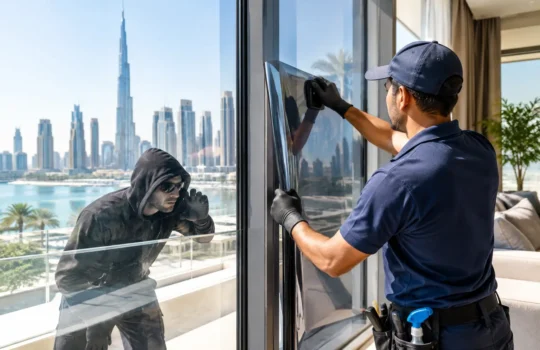
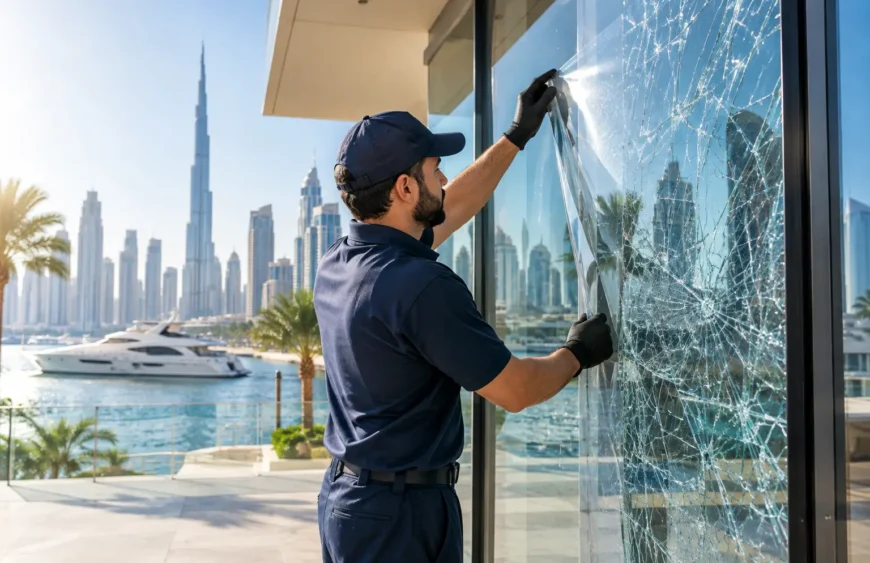
A broken window does not always leave one clean opening. In a villa, office, shopfront, or yacht cabin, the immediate hazard is often the loose, falling glass around that opening. Glass fragment retention is the function of safety window film designed to help hold broken glass together after impact, reducing the spread of fragments and making the area safer to manage.
That wording matters. Safety film is not glass replacement, and it does not make every window unbreakable. Its role is to improve what happens after glass breaks. The right system can help keep fragments bonded to the film and, depending on the glass, frame, impact, and installation method, can delay or reduce the release of broken glass into the room.
What glass fragment retention means in practice
Ordinary annealed glass commonly cracks into sharp, irregular pieces. Tempered glass breaks into many smaller pieces, but those pieces can still fall suddenly and travel some distance. Safety film is applied to the interior-facing side of existing glass. When the pane breaks, the adhesive and film work together to hold much of the fractured glass in place.
This can be useful where people sit, walk, sleep, or work close to glazing. Think of low-level windows in a home, glazed office partitions, retail frontage, or yacht windows where movement and vibration are part of normal use. It can also be relevant for areas exposed to accidental impact, such as a door beside a busy walkway or a window near a play area.
The result is not always visually neat. A filmed pane may crack in a spiderweb pattern, bow inward, or remain in the frame with visibly fractured glass attached to the film. That is often the intended outcome: the glass is damaged, but the fragments are less likely to scatter immediately.
Safety film helps after breakage, not before every impact
Customers sometimes expect security film to stop any attempted break-in or make a window impossible to penetrate. That is not a realistic promise. Performance depends on the thickness and construction of the film, the adhesive system, the existing glass, the frame, and the force applied.
A standard safety film may improve fragment retention significantly, while a more demanding security application may require a heavier film and a method that secures the film to the frame. This distinction is important. If broken glass remains attached to film but the entire filmed sheet can be pushed out of the frame, the opening is still created. Frame retention is therefore a separate consideration from fragment retention.
For a customer whose concern is accidental breakage and cleanup, a practical safety-film solution may be appropriate. For someone assessing forced entry, vulnerable glazing, or a high-risk commercial setting, the recommendation should start with a site assessment rather than a generic film specification.
The glass and frame determine the right approach
Safety film is not selected by window size alone. Before recommending a solution, a specialist needs to understand what is already installed. The key questions include whether the glass is annealed, tempered, laminated, insulated, or part of a specialist glazing system, as well as the condition of the seals, frame, and surrounding structure.
Laminated glass already contains an interlayer that is intended to hold broken pieces together. Additional film may still have a role for surface protection, privacy, or solar control, but the fragment-retention benefit should be assessed against what the existing glazing already provides.
Tempered glass presents a different case. It can break into a large volume of small pieces, and a suitable safety film can help contain those pieces. However, the final result depends heavily on the edge condition, how the panel is held in its frame, and the direction of impact.
Insulated glass units, large panes, curved glazing, and older frames require particular care. A film applied to the wrong glass type or in unsuitable conditions can create problems that have nothing to do with fragment retention, including compatibility concerns or unwanted visual effects. This is why an on-site review is more useful than selecting a film purely from a thickness number.
Why installation details matter as much as film selection
A safety film performs as a system, not as a sheet of material in isolation. Clean preparation, proper edge finishing, suitable curing conditions, and careful fitting around beads, handles, and seals all affect the result. A poor installation can leave vulnerable edges, contamination, lifting, or gaps that compromise both appearance and performance.
For higher-risk applications, the connection between film and frame becomes especially relevant. Some installations use an attachment method around the perimeter so the film can remain more securely associated with the frame after glass failure. Whether that is necessary depends on the threat being addressed and the construction of the existing window.
It is also worth being candid about limitations. No film can correct a loose frame, severely deteriorated seals, damaged glass, or a glazing system that was never suitable for the intended use. Those conditions should be addressed before film installation is considered.
Where safety window film is often a sensible option
Glass fragment retention is most valuable where the consequences of scattered glass are greater than the inconvenience of replacing a broken pane. In Dubai properties, that can include large low-level villa windows, glass doors opening to pool or terrace areas, offices with internal glazed partitions, and waterfront or marine environments.
It can also suit retail and commercial settings where a broken pane could expose staff or customers to loose shards before repairs can be arranged. The film may help keep the damaged area more contained, giving facilities teams a safer situation to secure and assess.
For homes, the decision often comes down to proximity. A high window above an inaccessible area presents a different concern from a full-height pane beside a dining table, child’s play space, or frequently used door. For offices, consider foot traffic, workstation locations, and whether the glazing separates occupied spaces.
Combining fragment retention with heat, glare, or privacy control
A safety-focused film does not have to be the only objective. Some projects also need reduced heat, glare control, UV filtering, or privacy. In the UAE, sun-exposed glazing can create a genuine comfort and cooling-demand issue, so it is reasonable to ask whether one film can address several needs.
The answer depends on the glass and the priority. A solar-control safety film may be appropriate in some situations, but darker is not automatically better. Visible light transmission affects how much daylight enters the room and how the glass looks from inside and out. Heat performance should be considered using total solar energy rejected, or TSER, rather than relying only on infrared rejection figures. A high infrared-rejection claim at a single wavelength does not by itself describe total solar heat reduction.
Privacy also changes with lighting conditions. Reflective or tinted films may provide useful daytime privacy when it is brighter outside than inside, but they do not create the same effect at night with interior lights on. If safety is the main concern, it is better to choose the safety system first and then determine whether the available finish meets the solar and privacy requirements.
Questions to ask before choosing a safety film
A practical consultation should establish what you are trying to reduce: accidental injury from shards, disruption after breakage, forced-entry vulnerability, sun exposure, or a combination of these. It should also identify the glazing type, pane dimensions, frame condition, and whether access is available on the required installation side.
Ask how the proposed film is expected to perform after breakage, whether frame attachment is relevant, and what limitations apply to your particular glazing. If solar control is included, ask for clear performance measures such as visible light transmission and TSER, not vague claims about heat blocking. The most suitable recommendation may be a clear safety film, a solar safety film, or a different glazing solution altogether.
When glass safety is the concern, the useful question is not simply, “How thick is the film?” It is, “What happens to this specific window when it breaks?” A careful assessment of that question gives you a more useful answer than a one-size-fits-all security claim.