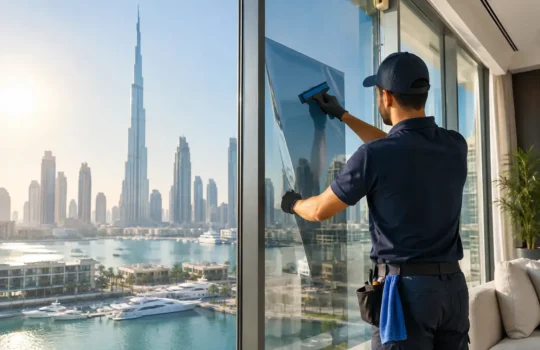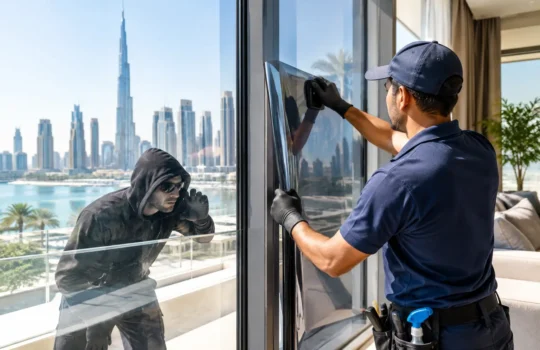
A switchable film review should begin with one point that is often missed: Smart Film is primarily a privacy solution, not a cure for solar heat. It can turn a clear glass partition opaque at the press of a switch, which is genuinely useful in Dubai villas, offices, clinics, meeting rooms, and bathrooms. But if the real problem is afternoon heat, glare, or high cooling demand through sun-facing windows, switchable film may not be the right first recommendation.
The right choice depends on what the glass needs to do when it is clear, when it is private, and how the installation can be powered and finished. Here is the practical view of where switchable film works well, where expectations need adjusting, and what should be checked before installation.
What Switchable Film Actually Does
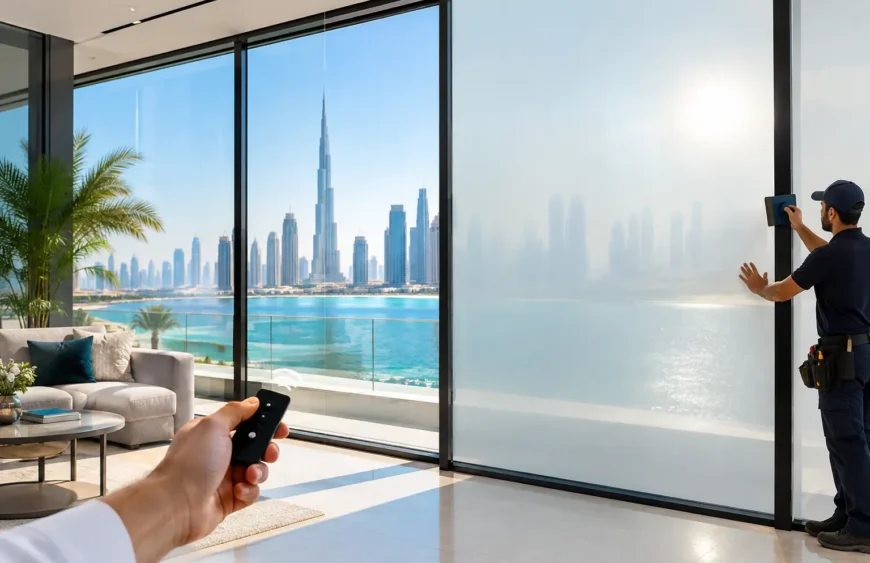
Switchable Smart Film is an electrically powered privacy film, commonly based on PDLC technology. When power is applied, the liquid crystal layer aligns and the film becomes clear or near-clear. When power is off, the crystals scatter light and the film changes to a frosted, opaque-looking finish.
That change happens quickly, but “opaque” needs context. In its private state, the film blocks a clear view through the glass. It does not usually create a blackout panel. Light still passes through as a soft, diffused glow, and shapes may be visible when someone is very close to the glass or where lighting conditions are uneven.
This makes it particularly suitable for internal glass partitions, executive offices, boardrooms, bathroom glazing, dressing areas, clinics, and spaces that need privacy only at certain times. It allows a room to stay open and light-filled when privacy is not needed, without relying on permanent frosting or curtains.
Switchable Film Review: The Benefits That Matter
The strongest reason to choose switchable film is flexibility. A meeting room can be transparent during normal office hours, then private during a confidential discussion. A bathroom window can admit daylight while private mode prevents a direct view. In a villa, it can create separation between a dressing room and bedroom without making the layout feel closed off.
It also offers a cleaner visual result than many temporary privacy solutions. There is no fabric to collect dust, no blinds to adjust, and no permanent pattern obscuring the view. When installed carefully, the film sits neatly on the glass and can be controlled by a wall switch, remote control, or, where the electrical design allows, an automation system.
For commercial interiors, the ability to change a room from transparent to private can improve how a space is used. A glass-fronted consultation room or meeting room may feel more welcoming when open, while still offering privacy on demand. This is a functional benefit, not just a design feature.
The Trade-Offs Before You Choose Smart Film
Switchable film needs a power supply. That sounds obvious, but it is often the main practical issue on completed projects. The electrical connection is typically routed to the edge of the glass, so planning the cable path, transformer location, and switching method matters as much as choosing the film itself.
On a new fit-out, wiring can often be concealed within a ceiling, wall, frame, or joinery detail. In a finished villa or office, a visible cable route may be unacceptable unless there is a practical way to hide it. A site assessment should identify this before the film is ordered, not after installation begins.
The film also has a different appearance in each mode. In clear mode, it is not always identical to untreated glass. Depending on the film, lighting, viewing angle, and size of the panel, there may be a slight haze or tint. In private mode, the surface looks frosted rather than perfectly white or perfectly solid. Customers who expect a completely invisible film when powered on, or a blackout screen when powered off, may be disappointed.
There is also an ongoing electrical requirement. When the film is in clear mode, it uses power. When the power is off, it returns to its private state. For many projects, this is a sensible default because privacy remains in place during a power interruption. However, it should be considered where the glass needs to stay clear continuously.
Is Switchable Film Effective for Heat and Glare?
This is where a candid review matters. Smart Film may reduce some light and provide some UV filtering depending on the product construction, but it should not be selected as a dedicated solar-control film without reviewing its actual tested performance.
For hot, sun-exposed glass in Dubai, the more useful figures are total solar energy rejected, often shortened to TSER, visible light transmission, and glare reduction. TSER describes how much of the sun’s total energy is rejected, including visible light, infrared energy, and ultraviolet energy. A higher infrared rejection figure alone does not tell the full heat-rejection story, because infrared figures can be measured at a single wavelength.
If a west-facing villa room becomes uncomfortable in the afternoon, or an office has glare on screens near large exterior glazing, a solar-control window film is generally the more direct solution. It can be selected for the required balance of heat reduction, glare control, exterior appearance, and natural light. Privacy film, decorative film, or switchable film can then be considered separately if privacy is also required.
There are projects where both needs exist, but the solution must be designed carefully. A switchable film installation on internal partitions is straightforward. Combining functions on exterior glass needs a review of the glass type, film layers, electrical requirements, and expected result. It is not a situation for assumptions.
Where Switchable Film Makes the Most Sense
The best applications are usually places where controllable visual privacy has a clear value. Boardrooms and meeting rooms are a common example, especially where permanent frosted glass would make the space feel smaller. Medical and wellness consultation rooms can benefit for the same reason.
In residential settings, switchable film can suit bathroom windows, internal glass doors, dressing rooms, and partitions between bedrooms and en suites. It can also work well in villas with open-plan layouts where a room occasionally needs separation without losing daylight the rest of the time.
For exterior-facing windows, privacy must be assessed according to daytime and nighttime lighting. Frosted switchable film blocks the view through the glass in private mode, but exterior lighting, interior lighting, and the position of the viewer can change what is perceived. A sample on the actual glass, viewed at the relevant time of day, is more reliable than judging the effect from a small showroom piece.
Glass Compatibility and Installation Quality
Not every glass panel should be treated in the same way. Before installation, a specialist should identify whether the glass is tempered, laminated, insulated, curved, textured, or part of a framed system. The size of each panel, access to edges, silicone joints, handles, hardware, and the condition of the existing glass all affect whether the finish can be clean and durable.
Large panels require particular care during measuring and installation. Switchable film is cut precisely, and the electrical busbars at the edge of the film must be connected, protected, and concealed as appropriately as the glass system allows. A small error in measurement or cable planning can be much harder to correct once the film is fitted.
Installation conditions matter too. Glass needs to be clean, stable, and accessible. A professional installer will discuss the finish around the edges, the control location, transformer access, and any limitations created by existing frames or joinery. This is not unnecessary detail. It is what separates a film that looks integrated from one that looks added on.
Questions to Ask Before Approving a Switchable Film Project
Ask what the film will look like in both clear and private modes on your specific glass. Ask how the power will be supplied, where the transformer will sit, and what happens during a power cut. If the glass receives direct sun, ask for solar-performance figures rather than assuming that privacy film will solve a heat problem.
It is also sensible to ask how the film will be controlled and whether the proposed control method suits the way the room is used. A wall switch may be ideal for a bathroom, while a meeting room may need remote control or integration with a room-control system. Finally, confirm how the film edges and wiring will be finished, because that detail has a major effect on the completed appearance.
At Dr SunShield, the useful starting point is not “Which Smart Film is most expensive?” It is whether switchable film is the appropriate response to the actual issue. If the priority is flexible privacy, it can be an excellent solution. If the priority is heat rejection, glare reduction, or preserving a clear outside view, another window-film option may be more practical.
The most satisfying Smart Film projects are planned around the room, the glass, and the daily routine of the people using it. A clear explanation of the desired private state, power route, and lighting conditions before installation will do more for the final result than any impressive product description.