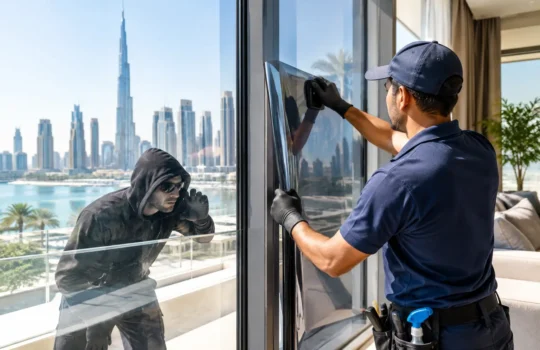
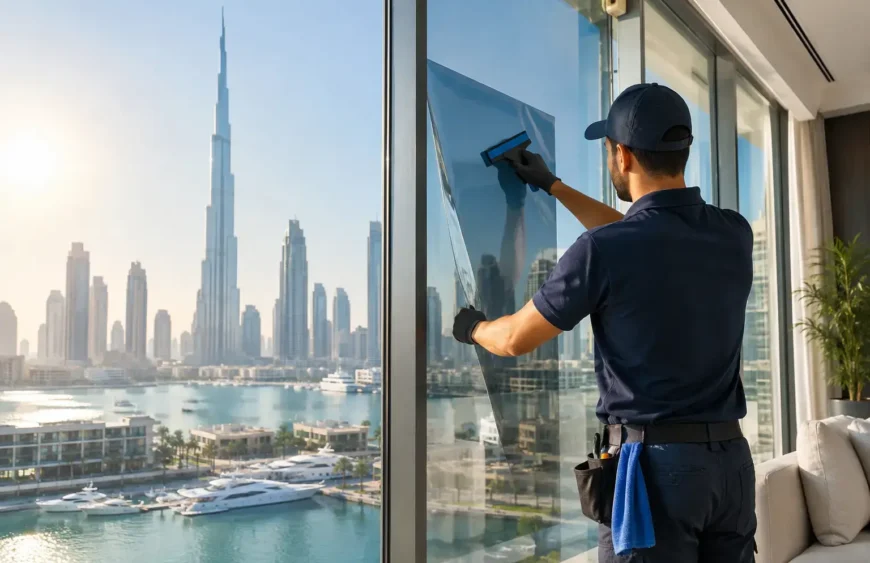
A shattered pane does not only create a cleanup problem. In a villa, office, storefront, or yacht, loose glass can injure people, damage interiors, interrupt operations, and leave an opening exposed until the glass is replaced. This safety film review explains what safety window film can realistically do, where it is most useful, and why the glass and frame matter as much as the film itself.
Safety film is often discussed as though every product solves the same problem. It does not. A clear film intended to retain broken glass serves a different purpose from a thicker security-focused system designed to resist forced entry for longer. The right recommendation begins with the event you are trying to manage: accidental breakage, impact, vandalism, or a need to slow unauthorized access.
What safety window film is designed to do
Safety window film is a clear, multi-layer polyester film applied to the inside surface of existing glass. When the glass breaks, the film can help hold fragments together rather than allowing them to scatter widely. That can reduce the immediate hazard from shattered glass and make cleanup more controlled.
This is particularly relevant around full-height glazing, glass doors, partitions, sidelights, shower-adjacent glazing, and areas where children, staff, or visitors move close to glass. It can also be considered where replacement glazing is not practical or where a property needs an added layer of glass-fragment retention without changing the appearance of the window.
The key word is “help.” Film does not make ordinary glass unbreakable. A sufficiently strong impact can still crack or break the pane. What changes is the way the broken glass behaves after impact, provided the film, glass, and installation method are suitable for the application.
Safety film review: safety, security, and solar film are different
The most common source of confusion is treating safety film, security film, and solar-control film as interchangeable. They may share a similar installation process, but their priorities differ.
A safety-focused film is selected primarily for fragment retention. It is generally clear, so it preserves the existing look and visible light transmission of the glass. Visible light transmission, or VLT, describes how much visible daylight passes through the glazing. With a clear safety film, any change in daylight is usually minimal, though the exact result depends on the glass already installed.
A security-focused film is typically thicker and may be paired with an attachment system that bonds the film to the frame. This matters because broken glass held in a film can still be pushed inward as one sheet if the edges are not secured. Frame attachment can improve resistance time in appropriate applications, but it must be planned around the frame construction, sealants, and site conditions.
Solar-control film is chosen to reduce heat and glare. It may offer some degree of glass retention, but that should not automatically be treated as a safety-film solution. Total solar energy rejected, often called TSER, indicates how much of the sun’s overall heat is rejected by a glazing system. It is useful for heat concerns, but it does not tell you how well a film will retain broken glass. Similarly, a high infrared rejection figure alone is not a complete measure of cooling performance or safety performance.
For a sun-exposed Dubai villa, a combined solution may be possible if both heat and glass safety are genuine priorities. However, it requires a proper review of the existing glazing rather than assuming one film can deliver every benefit at the highest level.
Where safety film makes practical sense
Safety film is often a sensible option where the main concern is accidental impact and glass fallout. For example, an internal glass partition near a busy office walkway may not need a forced-entry system, but it can benefit from improved fragment retention if it breaks. In this situation, a clear film may be more appropriate than a darker solar film or a heavier security specification.
It is also worth assessing older glass doors and windows that are close to seating areas, play areas, staircases, or pool-adjacent spaces. The goal is not to create a false sense of invulnerability. It is to reduce the risk associated with loose shards where people are most likely to be nearby.
Commercial properties may consider safety film for glazed doors, reception partitions, storefronts, and internal glazed areas. In these settings, appearance matters. A clear application can preserve the original design while adding a layer of protection against fragment scatter.
Marine glazing needs a separate assessment. Yacht windows are exposed to vibration, salt air, movement, curvature, and different glazing materials. A film suitable for a fixed residential pane should not be assumed suitable for marine glass without checking compatibility and installation conditions.
What determines real-world performance
Film thickness matters, but it is not the full answer. The performance of a safety-film installation depends on the complete glass assembly: glass type, pane size, frame strength, seal condition, edge clearance, and whether the film is attached to the frame.
Annealed glass, tempered glass, laminated glass, and insulated glass units break differently. Tempered glass, for example, can break into many small pieces. A film may help retain those pieces, but the outcome depends on how the glass was manufactured, how it is held in the frame, and the type of impact. Laminated glass already includes an interlayer designed to hold glass together, so the benefit of adding film must be judged against the existing construction and the specific problem being addressed.
Large panes deserve particular care. A large, broken sheet of glass can be heavy even when film holds it together. In some cases, retaining the panel is helpful; in others, the load placed on the film and frame needs careful consideration. This is why a site inspection is more valuable than selecting a thickness from a brochure.
The edges also matter. A standard film installation stops short of the frame to allow proper finishing and avoid interference with gaskets or seals. Where a project requires higher resistance to penetration, an engineered edge-retention or frame-attachment approach may be needed. Not every frame can accept it, and not every safety concern justifies the additional work.
Glass compatibility should come before installation
Applying film changes how glass absorbs solar energy. On some glazing types, particularly where there is existing tint, coating, insulation, partial shading, or significant heat exposure, an unsuitable film can increase thermal stress. That can raise the risk of cracking in certain circumstances.
A professional assessment should identify the glass type where possible, inspect for existing damage, check the condition of seals and frames, and consider sunlight exposure throughout the day. Dubai properties often have strong direct sun on one elevation and deep shade on another. A recommendation that works on a shaded internal partition may not be appropriate for an external west-facing insulated glass unit.
This is also where customer priorities need to be separated clearly. If your main issue is glare on screens, solar film may be the better starting point. If you need daytime privacy, the internal and external lighting balance will influence whether a privacy film works as expected. Privacy film does not guarantee privacy at night when interior lights are brighter than outside. If the concern is broken-glass retention, safety film should be assessed on that basis instead of being chosen for a feature it does not provide.
Questions worth asking before you proceed
A useful consultation should leave you with clear answers rather than a generic claim that a film is “security grade.” Ask what kind of glass you have, whether the proposed film is intended for fragment retention or delayed entry, and whether frame attachment is recommended. You should also understand what the installation will look like at the edges, how long the film needs to cure, and how to clean it afterward.
For occupied offices and homes, installation planning matters too. Interior application is usually less disruptive than replacing glass, but access, furniture movement, working height, and cleanliness still need to be managed. Film should be installed on properly prepared glass by technicians who can identify issues such as chips, damaged seals, old adhesive residue, or unsuitable glazing before they become a problem.
At Dr SunShield, that practical review is central to the recommendation. The appropriate option may be a clear safety film, a more substantial security-focused system, a solar-control film for heat, or no film at all if the glass or application requires a different approach.
Safety film is most valuable when it is specified for a clear, realistic purpose. Start with the glass you have, the event you want to reduce risk from, and the limits you are willing to accept. That conversation leads to a safer decision than choosing a film based on thickness or a broad label alone.