A large pane of glass can look perfectly safe right up to the moment it breaks. A flying object, an accidental impact, a door slam, or pressure from severe weather can turn fractured glass into a serious cleanup and injury risk. When customers ask whether to install safety film, the useful question is not simply which film is thickest. It is what type of glass is already in place, what hazard they are addressing, and whether the frame can help retain the glass.
Safety film is a clear or lightly tinted polyester film applied to the inside surface of existing glazing. Its primary purpose is to hold broken pieces together after impact. It can be a practical retrofit for villas, offices, shopfronts, internal glass partitions, and other locations where replacing the glass would be disruptive or unnecessary. But it is not a substitute for every form of safety glass, and its performance depends heavily on correct specification and installation.
What safety film does after glass breaks
Ordinary glass can fracture into sharp, loose pieces. Safety film bonds to the glass and helps keep those fragments contained, reducing the chance that shards scatter into a room or walkway. In many situations, the pane will crack but remain largely in its frame long enough for the area to be made safe and the glass to be replaced.
That distinction matters. Safety film does not make a window unbreakable. A determined impact can still crack or penetrate the glass, particularly where the pane is thin, large, poorly supported, or hit near an edge. The film is designed to improve fragment retention and delay opening creation, not to promise that a glazed opening will withstand every event.
For a villa, this may mean reducing the danger from a broken sidelight beside an entrance door or a large low-level window near a play area. In an office, it may help contain glass from an internal partition or a perimeter window exposed to accidental impact. The appropriate solution depends on the risk, not the appearance of the glass alone.
Safety film, security film, and solar film are not identical
These terms are often used interchangeably, but they describe different priorities. Safety film focuses on holding shattered glass together. Security film generally aims for greater tear resistance and longer forced-entry delay, especially when paired with a suitable frame-retention system. Solar-control film is chosen primarily for reducing heat, glare, and UV exposure, although some solar films may also provide a degree of fragment retention.
A customer with harsh afternoon sun on a Dubai villa may need solar control first. Total solar energy rejected, or TSER, indicates how much of the sun’s total heat is blocked or rejected by the glazing system. Visible light transmission indicates how much natural light still enters. Neither figure, by itself, tells you how effectively a film will retain glass after breakage.
Likewise, a high infrared rejection figure should not be confused with overall heat reduction or safety performance. Infrared rejection can be measured over a particular range of wavelengths, while TSER gives a broader view of solar heat performance. A clear safety film may preserve the room’s existing daylight very well, but it will not usually deliver the same solar control as a purpose-selected heat-reduction film.
When both safety and solar control matter, the glass, exposure, desired shade, and risk level should be assessed together. Combining objectives is possible in some applications, but the best answer is not always the darkest or most expensive film.
Where it makes sense to install safety film
Safety film is particularly worth considering on vulnerable existing glass that is otherwise in good condition. Examples include low-level residential glazing, glazed doors, side panels near entrances, internal partitions, office glass near circulation routes, and areas where a broken pane could fall into an occupied space.
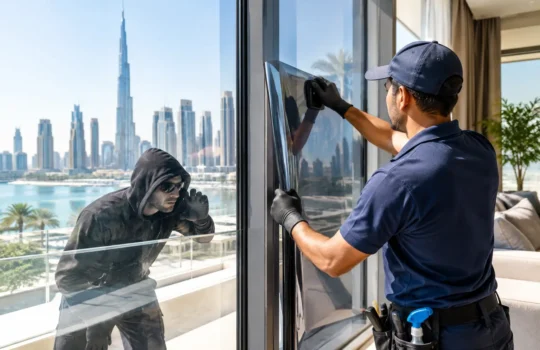
It can also be relevant for commercial premises that want an additional layer of protection against accidental damage or smash-and-grab incidents. Here, expectations should be clear: a film-only installation may hold fragments together, but a higher-security objective often calls for thicker material and a retention method that bonds the film to the frame.
For external windows, exposure matters. Strong sun, large panes, wind load, and building movement can all affect the right recommendation. Marine glazing requires its own assessment because salt, moisture, curved surfaces, and the type of vessel glass introduce different installation conditions.
Glass compatibility comes before film selection
Professional assessment begins with the glass. Is it annealed, tempered, laminated, insulated, or part of a double-glazed unit? Is there an existing coating? Are there signs of damaged seals, chips, scratches, or edge stress? These details influence both film suitability and the risk of thermal stress.
Tempered glass breaks into many small pieces rather than long sharp shards, but that does not automatically mean film has no value. Applied safety film can help retain those pieces after breakage. Laminated glass already incorporates an interlayer intended to hold fragments together, so the additional benefit of safety film needs to be considered against the actual risk and desired outcome.
Double-glazed units deserve particular care. Applying film changes how the glass absorbs and rejects solar energy. With certain glass types, shades, orientations, or pre-existing defects, this can increase thermal stress. That does not mean film cannot be used on insulated glass. It means compatibility should be checked before work begins, rather than assumed from a photo or a general product description.
The frame is equally important. A film can hold broken glass together, but the entire filmed pane may still leave the frame under a strong impact if there is no effective attachment at the edges. For applications where containment after breakage is critical, a mechanical or structural attachment system may be recommended. The right level of retention depends on the type of threat, the frame construction, and the consequences if the pane fails.
The professional process to install safety film
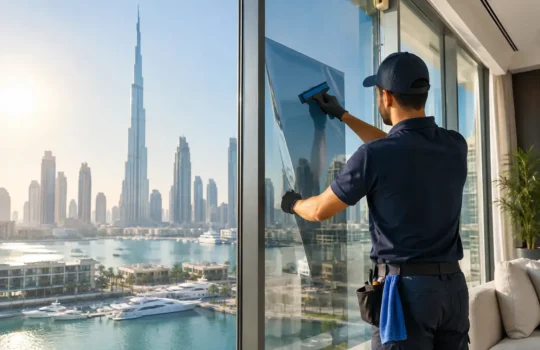
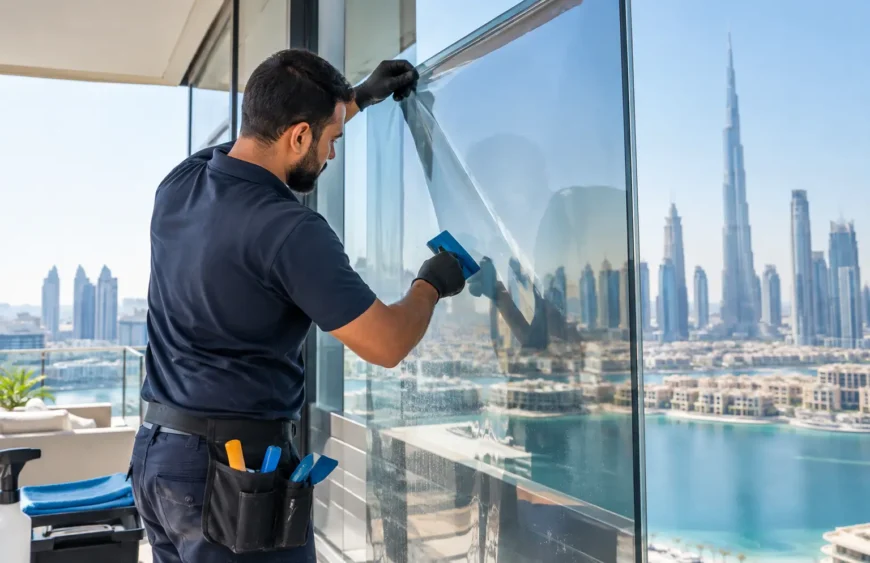
Installing safety film properly is more involved than placing a clear sheet on glass. The visual finish and the safety function both depend on preparation, edge detailing, and clean working conditions.
First, the installer confirms the glass type, measurements, access, frame condition, and the reason for the installation. At this stage, it is useful to identify whether the main concern is accidental breakage, occupant safety, privacy, forced-entry delay, or solar comfort. A meter demonstration may help compare solar performance where relevant, but it does not prove how a complete window will react to a real impact.
Next, the glass is thoroughly cleaned. Dust, paint residue, silicone contamination, and airborne debris can prevent proper bonding or leave visible imperfections. The film is cut accurately, positioned using an application solution, and squeegeed methodically to remove moisture and air. Edges are trimmed with care so the film sits neatly within the usable glass area.
Where frame retention is part of the specification, the attachment detail is installed only after the surface preparation and film placement meet the required conditions. This step should not be treated as an optional cosmetic extra when the goal is to keep the broken pane in the opening.
Finally, the film needs time to cure. Small water pockets or a slight hazy appearance can occur during the drying period, particularly with thicker films or humid conditions. This normally improves as the installation solution evaporates. The glass should not be aggressively cleaned immediately after installation, and any aftercare instructions should be followed.
Common mistakes that weaken the result
The most common mistake is choosing a film based only on thickness. Thickness can matter, but it does not replace an assessment of the glass, frame, impact risk, and edge-retention requirement. Another mistake is applying film over damaged glass or failing seals, then expecting the film to correct an underlying glazing problem.
DIY installation also has limits. A small, accessible internal pane may look straightforward, but contamination, poor edge cuts, trapped moisture, and incomplete adhesion affect both appearance and long-term performance. Large panels, high-access glazing, doors, curved glass, and security-focused applications are better handled by trained installers with the right preparation and access equipment.
Customers should also avoid treating safety film as a universal building-code upgrade. Some locations may require specific safety glazing or tested systems for compliance. Where code compliance, public safety, or a high-risk application is involved, the required standard should be verified before selecting a retrofit approach.
Choosing the right outcome for your glass
The right recommendation can be surprisingly simple. If the concern is mainly broken-glass fragments on a low-level internal pane, a clear safety film may be the sensible, cost-conscious choice. If the concern is a street-facing commercial window and intrusion delay, a security-focused system with appropriate frame attachment may be more suitable. If a sun-facing room also suffers from glare and cooling demand, safety may need to be evaluated alongside solar-control performance and glass compatibility.
A careful site review prevents a familiar problem: paying for a film that solves a different issue than the one you actually have. The most useful next step is to identify the glass, the location, and what should happen after an impact. From there, the film and installation method can be selected for the real conditions, not just the label on the roll.