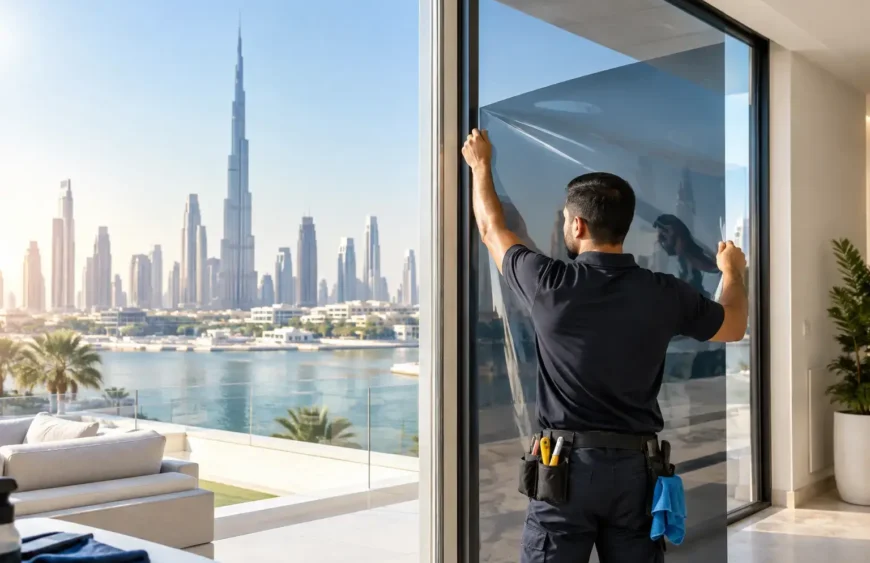
A meeting-room partition can look completely open one moment and turn white at the touch of a switch the next. That leads to a reasonable question: are smart films opaque? Not in the strict sense. Most switchable Smart Film is designed to become frosted or translucent when switched off, rather than solid, blackout opaque. It provides very effective visual privacy in many applications, but it still allows light through.
That distinction matters in Dubai villas, offices, clinics, and hospitality spaces, where privacy, daylight, interior lighting, and the view through the glass can all affect whether Smart Film is the right choice. The best result depends on what you need to hide, when you need to hide it, and how the glass is used.
Are Smart Films Opaque When Switched Off?
The common type of switchable privacy film uses liquid-crystal technology, often called PDLC. When power is supplied, the liquid crystals align and the film becomes clear. When power is removed, the crystals scatter light, giving the glass a frosted white appearance.
In its frosted state, Smart Film prevents a clear view through the glass. You cannot normally read a screen, recognize facial detail, or see activity clearly on the other side. For a glass office partition, bathroom window, consultation room, or villa interior divider, that is often exactly the level of privacy required.
However, frosted is not the same as opaque. The film transmits diffused light, and strong shapes close to the glass may remain visible as soft silhouettes. If someone stands directly behind a switched-off partition, a person on the other side may detect movement and general form. The effect is similar to looking through quality frosted glass rather than looking at a painted wall.
If your requirement is total visual blockage at all times, including no silhouettes under strong lighting, a different treatment or a physical covering may be more suitable. Smart Film should be selected for controllable privacy and light transmission, not on the assumption that it creates a complete blackout surface.
What You Can and Cannot See Through Smart Film
When the film is clear
When switched on, Smart Film becomes transparent enough for everyday viewing through the glass. It is useful where an open visual connection is valuable, such as an office, entrance feature, interior room divider, or a bathroom partition that needs privacy only when occupied.
Clear does not always mean identical to bare glass. The appearance can be influenced by the original glass, reflections, viewing angle, lighting, and the installation itself. On a large glass wall, this is usually a subtle difference. On very clear feature glass or in a design-led interior, it should be assessed carefully before approval.
When the film is frosted
When switched off, the glass becomes a bright, diffused privacy panel. It blocks direct sightlines while still allowing natural or artificial light to pass. That makes spaces feel less enclosed than they would with a solid door, blind, or permanent opaque film.
The limitation is most noticeable in high-contrast conditions. A brightly lit room behind the film and a darker viewing area can make silhouettes more apparent. The same principle applies at night: if lights are on inside and it is dark outside, any translucent privacy solution should be evaluated under those conditions.
For this reason, a proper assessment considers both daytime and nighttime use. A client who wants a boardroom to conceal confidential documents on a table may need more than frosted switching alone. A client who wants people passing a corridor to stop seeing into a treatment room may find Smart Film highly effective.
Smart Film Privacy Depends on Lighting
Privacy film is often discussed as if it has one fixed performance level. In reality, lighting is part of the system.
A frosted Smart Film panel diffuses light from both sides. If the room behind it is evenly lit, the panel will look consistently private. If a person stands close to it under a spotlight, their outline may show more clearly. Likewise, a large digital screen or a brightly lit object placed close to the glass may create visible shapes.
This does not make Smart Film unsuitable. It simply means the layout should support the privacy goal. Keeping seating, workstations, treatment beds, or storage a sensible distance from the glass often improves the result. In sensitive spaces, lighting design and the placement of interior furniture deserve the same attention as the film itself.
For exterior-facing glass, it is also worth separating Smart Film from one-way daytime privacy film. Reflective or tinted solar-control films can reduce daytime visibility into a brighter interior or exterior condition, but they do not guarantee privacy after dark when the light balance reverses. Smart Film offers switchable obscurity, while solar-control film manages heat, glare, and daylight. They solve different problems.
Does Smart Film Block Sun Heat, UV, and Glare?
Not necessarily to the degree customers expect. The primary role of standard Smart Film is controllable visual privacy. It can diffuse glare when frosted and filter some ultraviolet light, but it should not automatically be treated as a replacement for a dedicated solar-control window film.
In a Dubai villa with large sun-exposed glazing, heat entering through the glass is usually the bigger issue. That is where total solar energy rejected, or TSER, becomes relevant. TSER describes how much of the sun’s total energy a film rejects, including ultraviolet, visible light, and infrared energy. It is more useful for judging overall heat-control performance than an infrared rejection figure taken at one wavelength alone.
A solar-control film can also reduce glare and manage visible light transmission, often called VLT. VLT is the percentage of visible light that passes through the glass and film. Lower VLT generally means a darker appearance and less glare, but it can reduce daylight and alter the look of the glass. Smart Film in its frosted mode changes the quality of light rather than simply darkening it.
Some projects may require both privacy control and solar control, but that must be checked case by case. Combining products, applying film to existing glass, and locating electrical connections all require an assessment of glass type, edge conditions, heat exposure, and manufacturer suitability. It is not a situation for assuming that every film can be layered onto every window.
Where Switchable Privacy Film Makes Sense
Smart Film is particularly practical where privacy needs to change during the day. In offices, it can turn a glass meeting room private for a call or presentation, then restore an open feel afterward. In villas, it can provide privacy to an interior bathroom partition, dressing area, or glass divider without permanently sacrificing daylight.
It also works well in clinics, salons, and hospitality spaces where discretion matters but a solid wall would make the interior feel closed in. In these settings, the frosted state can be used for privacy and the clear state for openness, supervision, or a more spacious visual effect.
For exterior villa windows, Smart Film is less often the most practical first answer if the main concern is afternoon heat, glare, or permanent privacy from neighboring properties. A carefully chosen privacy, decorative, or solar-control film may be simpler, lower cost, and better aligned with the problem. The right recommendation should follow the actual use of the glass, not the appeal of the technology.
Installation Details That Affect the Result
Smart Film is an electrical product as well as a window-film installation. It needs a suitable power supply, wiring route, switching method, and a tidy plan for concealing or managing connections. For new fit-outs, these requirements can often be incorporated early. For finished interiors, the route to power may influence whether the project is practical and how clean the final appearance can be.
The condition and type of glass also matter. Glass partitions, doors, insulated units, curved sections, patterned glass, and areas exposed to moisture or direct weather can each require different consideration. Accurate measuring is essential because switchable film is made to suit the panel, and cutouts or electrical connections need to be planned before installation.
A professional consultation should also clarify what will happen during a power outage. With typical PDLC Smart Film, the default state is frosted when power is off. Many customers see that as a privacy benefit, but it should be confirmed against the intended use of the room.
A Practical Way to Choose
Start with the privacy standard you actually need. If you want to stop direct views while keeping a bright, modern glass feature, Smart Film is often a strong option. If you need a genuinely solid visual barrier, including no discernible shadows, it may not be enough on its own.
Then consider timing. Permanent daytime privacy may call for a decorative or privacy film. Heat and glare on sun-facing glass may call for solar-control film with performance selected around the glass and exposure. Privacy that needs to appear and disappear during the day is where switchable Smart Film earns its place.
The most useful question is not whether Smart Film is fully opaque. It is whether frosted, light-transmitting privacy is right for the way your space is used. Seeing a sample under the actual lighting conditions and discussing the glass, wiring, and expected level of concealment will give a far clearer answer than choosing from a photo alone.