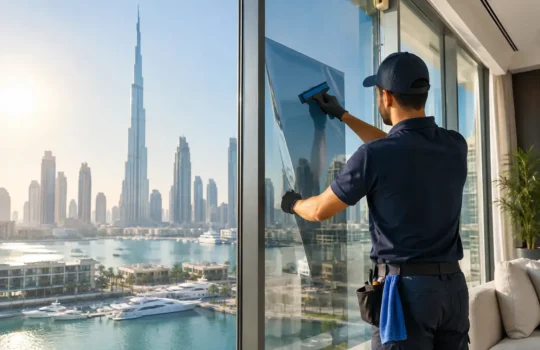
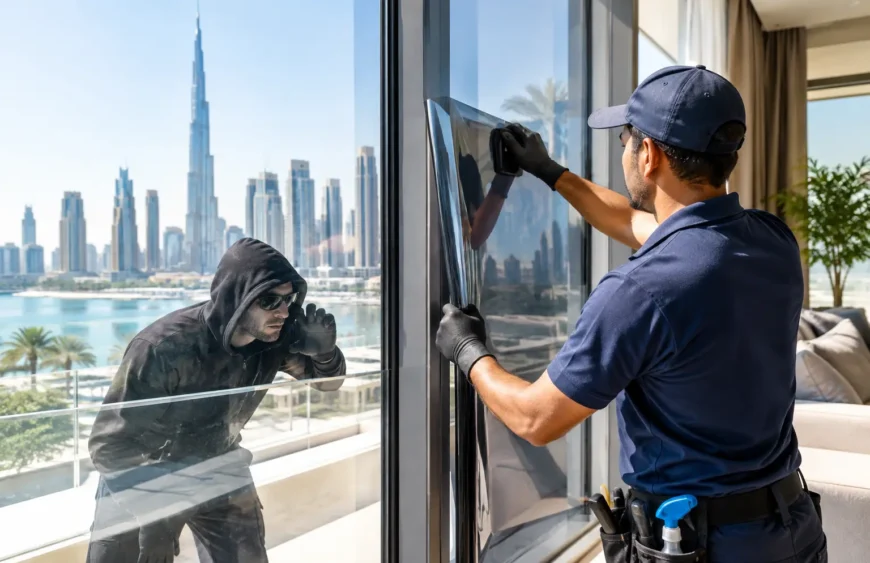
A smashed window is often the quickest route into a property. So, can safety film stop intruders? It can make forced entry slower, noisier, and considerably less straightforward by helping keep broken glass in the frame. But film is not a replacement for a properly specified security system, strong locks, or suitable glazing. Its value is in buying time and reducing the immediate opening created when glass breaks.
For villas, offices, storefronts, and ground-floor glazing in Dubai, that extra delay can be meaningful. It may give occupants time to react, security staff time to respond, or an intruder a reason to leave. The right result depends on the film construction, the glass, the frame, and how the film is installed.
How Safety Film Resists Forced Entry
Safety and security window film is a clear, multi-layer polyester film installed on the interior surface of existing glass. When glass is struck, the adhesive helps hold the fractured pieces together rather than allowing them to fall away immediately.
Without film, standard annealed glass can break into large, loose pieces that may be pushed out quickly. With a correctly selected safety film, the pane may crack in the same way, but it remains as a broken sheet. An intruder then has to continue striking, cutting, or pushing through the filmed glass to create an opening large enough to enter.
That distinction matters. The glass is still damaged, and the film does not make it unbreakable. What it does is turn one hard impact into a more prolonged, conspicuous attempt to get through the opening.
Delay is the realistic security benefit
Security film is best described as a delay measure. It can deter opportunistic break-ins because repeated impacts create noise, visible damage, and time pressure. It also limits flying shards, which is why similar films are used where accidental breakage, storm debris, or glass fragmentation is a concern.
The length of delay is not a fixed number. A thin safety film on a small, well-supported pane behaves differently from a thicker security film on a large pane with a weak frame. The attack method also matters. There is no responsible way to promise that film will stop every determined intruder.
Safety Film Versus Security Film
These terms are often used together, but they can describe different priorities. A lighter safety film is commonly selected to retain fragments after accidental breakage. It can offer some resistance to forced entry, but its main purpose may be reducing the risk of falling or flying glass.
A security-focused film is generally specified where delaying forced entry is the priority. It is usually thicker and may require a retention system that bonds the film to the frame. This edge attachment is particularly relevant on accessible doors, ground-floor windows, sidelights, and other glazing where someone could try to push the entire broken pane inward.
A practical assessment should consider more than film thickness. The installer needs to look at:
- the type and thickness of existing glass
- the frame material, condition, and depth of the glass rebate
- pane size and whether the glazing is fixed or operable
- how accessible the window is from outside
- whether the goal is safety, intrusion delay, privacy, or a combination of these needs
The most expensive film is not automatically the appropriate answer. For example, a family may need fragment retention on a glass partition, while a villa owner may need a security-focused solution on a side entrance. They are different risks and should be treated differently.
What Film Cannot Do on Its Own
A common misunderstanding is that security film turns ordinary glass into laminated security glazing. It does not. Laminated glass is manufactured with an interlayer between glass sheets, while retrofit film is applied to one surface of existing glass. Both can help retain broken glass, but they are not identical systems.
Film also cannot compensate for a poor frame, loose beading, damaged seals, or a weak lock. If the entire glazed unit can be removed or the door hardware can be bypassed easily, the film may not address the main vulnerability.
For high-risk locations, safety film should sit within a wider approach that may include suitable locks, access control, lighting, alarms, cameras, and, where appropriate, upgraded glazing. Dr SunShield’s role is to assess whether film is a sensible part of that approach, rather than suggesting it solves every security concern.
Glass compatibility matters
Not every glass type should receive the same film. Tempered glass, insulated glass units, laminated glass, patterned glass, and certain coated or heat-absorbing panes require careful review before installation. Applying the wrong film can affect thermal stress and may not produce the intended performance.
This is particularly relevant in the UAE, where large areas of glazing are exposed to intense sun. A film selected for security may also alter solar absorption, visible light transmission, glare, or privacy. Visible light transmission describes how much natural light passes through the glass and film together. A clearer security film generally preserves daylight, while a tinted or reflective option may change the appearance and daytime privacy.
If heat reduction is also a priority, the selection must be made carefully. Total solar energy rejected, or TSER, is the broader measure of how much solar energy a film rejects. It is more useful for comfort and cooling considerations than a single infrared rejection figure. A security requirement does not automatically mean a heat-control film is the right match, and vice versa.
Where Intrusion-Resistant Film Makes Sense
Safety and security film is often worth considering on accessible glazing rather than every window in a property. Typical examples include glass entrance doors, sidelights beside doors, low-level villa windows, retail frontage, office doors, internal glass partitions, and glazed areas near pools or busy walkways.
For a villa, the concern may be a secluded side window or a rear sliding door. In an office, it may be an entrance partition that could be broken to reach an access-controlled area. In a commercial setting, it may be the need to keep broken storefront glass together until the site can be secured.
A clear film is often preferred when maintaining the original look and natural light is the priority. Where privacy is also needed, a different film approach may be considered, but privacy should not be confused with security. Frosted decorative film obscures a view; it does not provide the same forced-entry resistance as a specified safety or security film.
Installation Determines Whether the Film Performs as Intended
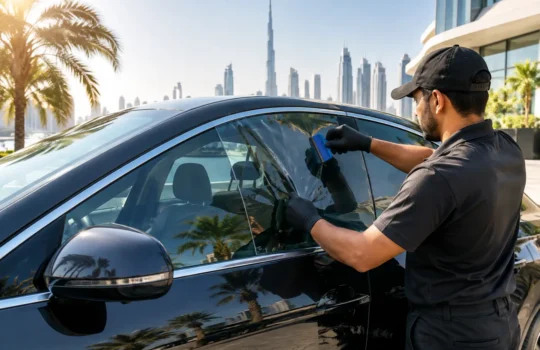
Security film relies on clean preparation, correct cutting, full adhesive contact, and proper finishing around edges. Rushed installation, contaminated glass, poor edge work, or unsuitable conditions can reduce adhesion and leave weak points.
For higher-risk applications, the detail at the edge of the glass deserves as much attention as the film itself. An installer should inspect the frame and explain whether a frame-retention method is suitable. This is one reason a site assessment is more useful than choosing a film only by its thickness or an online description.
After installation, the film needs time to cure. During this period, minor haze or water pockets can be normal depending on conditions and film type. The glass should be cleaned according to the aftercare guidance, using a soft cloth and non-abrasive cleaning method. Any existing chips, scratches, seal failures, or glass defects should be identified before work begins.
Questions to Ask Before Choosing Safety Film
Ask what problem you are solving first. Is the main concern accidental breakage, delayed forced entry, fragment retention, privacy, sun exposure, or several of these at once? Then ask how the proposed film will work with your specific glass and frame, whether frame attachment is recommended, and what visual change to expect after installation.
It is also reasonable to ask about warranty coverage and the limits of the proposed system. A transparent recommendation should explain what the film can reasonably improve, what it cannot secure, and whether another measure should be addressed before installation.
For accessible glass, the sensible goal is not to make dramatic promises about invincibility. It is to make the opening harder to exploit, retain dangerous fragments, and choose a solution that respects the existing glass, the building’s use, and the people inside it. That is where a properly assessed safety film installation earns its place.