A cracked window after an impact creates two separate concerns: whether the glass stays together and whether the opening remains difficult to pass through. Safety film versus laminated glass is not a simple stronger-versus-weaker choice. Both can help retain broken glass, but they do it differently, suit different stages of a project, and have different limits once the glass and frame are under real force.
For a completed villa, office, retail frontage, or glazed partition in Dubai, safety film is often the practical retrofit route. For new construction, major glazing replacement, or applications where the glass specification must meet a particular safety standard, laminated glass may be the more suitable starting point. The right answer depends on the risk you are managing, the existing glass, the framing system, and whether solar heat or privacy is also part of the brief.
How safety film and laminated glass work
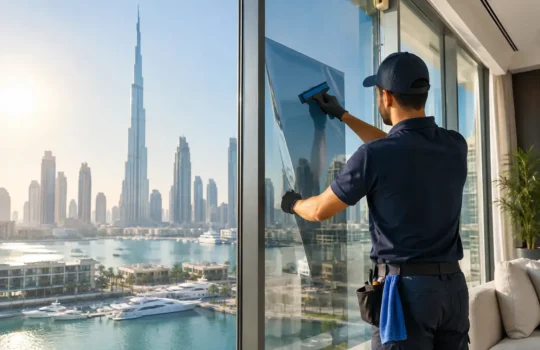
Safety film is a clear or tinted polyester film professionally applied to the inside surface of existing glass. Its primary purpose is to help hold glass fragments together after breakage. When a pane cracks, the film can reduce the spread of loose shards into the room, helping limit injury risk and cleanup.
The film does not stop the glass from breaking. A severe impact can still crack or break the pane, and the retained glass may still need prompt replacement. Its performance also depends on film thickness, adhesive, glass condition, the size of the pane, frame strength, and how the film is finished at the edges.
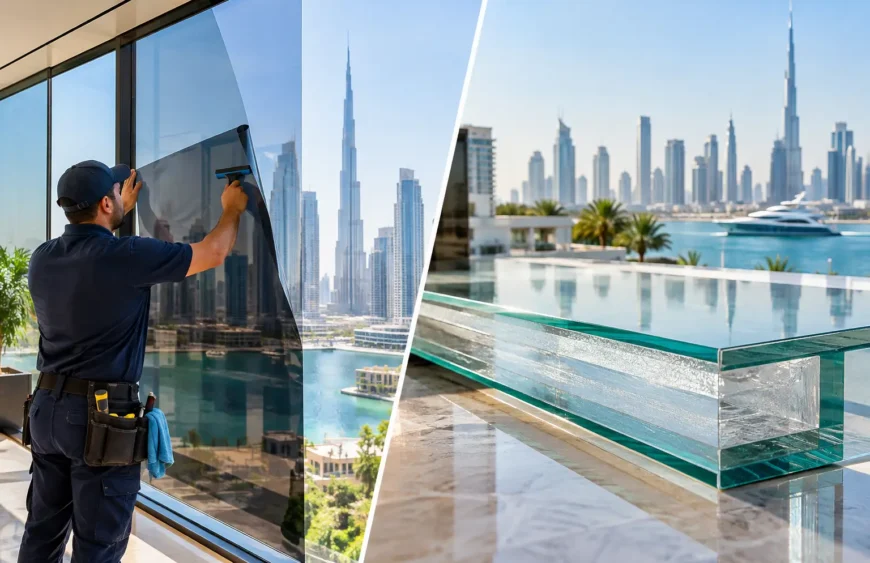
Laminated glass is manufactured as a glass assembly. It uses two or more glass sheets bonded around an interlayer. When it breaks, that interlayer is designed to retain the fragments. Because the retaining layer sits within the glazing rather than on one surface, laminated glass is a built-in glass-retention solution.
A laminated pane can still crack visibly after impact. That is normal behavior, not necessarily failure. The key benefit is that the fractured glass is more likely to remain in the opening rather than falling away in pieces.
Safety Film Versus Laminated Glass for Existing Windows
For existing glazing, replacing every pane with laminated glass can be disruptive and costly. It may require new glass units, site access planning, measurement, removal work, and a review of whether the existing frames can accept the new glass thickness and weight. This is often justified during construction, refurbishment, or when damaged glass already needs replacement.
Safety film can be installed onto suitable existing glazing without removing the pane. That makes it useful for occupied villas, offices, shops, schools, and glass partitions where minimizing disruption matters. Installation is typically completed from the accessible interior side, provided the glass is clean, sound, and reachable.
There are limits. Film should not be treated as a blanket solution for every pane. Older glass with chips, cracks, failed seals, or edge damage should be assessed first. Very large panes, certain framing arrangements, and high-risk security requirements may call for a more detailed system design. In some situations, edge-retention attachment to the frame may be considered to improve how long the filmed glass stays in place after breakage. Whether that is appropriate depends on the glass, frame, and intended level of protection.
Breakage Retention Is Not the Same as Security
Customers often use the terms safety film and security film interchangeably, but the objective should be clear before selecting either solution.
Safety-focused film is commonly chosen to reduce the chance of shattered glass entering an occupied space after accidental impact, a slammed door, a ball strike, or a broken glazed partition. It can be a sensible addition where people work or move close to glass.
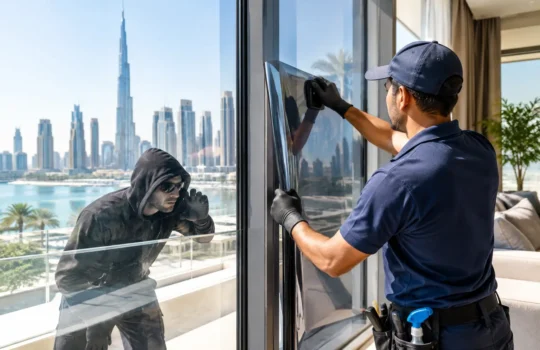
Security-focused specifications are intended to delay forced entry or make it harder to create an opening quickly. That outcome is not determined by the film alone. It relies on the film construction, attachment method, pane size, frame condition, locks, and the force applied. An intruder may still break the glass. The practical aim is delay and glass retention, not an unsupported promise that access is impossible.
Laminated glass can offer strong breakage retention and can be specified for higher-risk applications, but its security performance also varies by build-up. A basic laminated unit and a purpose-designed security glazing system should not be assumed to perform the same way. If a project has a regulatory, insurance, or security requirement, the glazing specification should be verified against that requirement rather than selected by description alone.
Heat, Glare, and UV: Do Not Assume Either Solves Them
In the UAE, glass safety is often only one part of the problem. A west-facing villa room may also have uncomfortable afternoon heat and glare. An office may need screen comfort without making its perimeter spaces too dark. Neither safety film nor laminated glass automatically delivers meaningful solar control.
A clear safety film may have little visible change and little impact on solar heat gain. Similarly, standard laminated glass may provide fragment retention but may not substantially reduce heat or glare unless it has been designed with solar-control properties.
This is where the specification needs separating into measurable priorities. Total solar energy rejected, or TSER, indicates how much of the sun’s total heat energy is rejected by the glass-and-film system. It is more useful for comfort decisions than quoting infrared rejection alone, because infrared figures may refer only to a selected wavelength range.
Visible light transmission, or VLT, describes how much visible daylight passes through. Lower VLT can reduce glare and increase daytime privacy, but it also makes the room darker and can alter the appearance of the facade. UV protection helps reduce exposure that contributes to fading, although no window treatment can eliminate all causes of fading, including heat, visible light, and interior lighting.
A suitable safety film can sometimes be paired with solar-control benefits, but the final result depends on the selected film and existing glass. It should be evaluated as a complete glass system, not as a film claim in isolation.
Glass Compatibility Matters Before Film Installation
Applying any window film changes how the glass absorbs and releases solar energy. On some panes, especially where there is strong direct sun, partial shading, dark frames, or unusual glass construction, an unsuitable film can increase thermal stress. That is why professional assessment should include the glass type, pane dimensions, existing tint or coating, frame details, orientation, and interior conditions.
Double-glazed units need particular care. Their performance is affected by the make-up of the unit, including coatings and air or gas spaces. A film that suits one single-pane window may not be appropriate for a double-glazed facade. Tempered glass, annealed glass, laminated glass, and insulated units all require different checks.
This assessment is also the point to discuss appearance. A clear safety film may preserve the current look, while a tinted solar-safety option can change reflection, interior brightness, and daytime privacy. At night, privacy reverses when interior lights are brighter than outside, so no ordinary film should be presented as complete nighttime privacy.
When Laminated Glass Is the Better Choice
Laminated glass is often the more logical option when glazing is being replaced anyway, when a project specification requires it, or when the design needs glass retention built into the unit from day one. It is particularly relevant for new villas, large facade projects, skylights, balustrades, and locations where the glazing assembly must be selected as part of the building design.
It may also be preferred when the existing glass is unsuitable for film or the frame and installation conditions make retrofit edge retention impractical. The trade-off is that replacement is more intrusive and usually requires coordination with a qualified glazing contractor.
For customers renovating a property, this is a useful decision point: if the panes are already being changed, specify the safety and solar characteristics together. If the existing glass is in good condition and the main need is improved shard retention with minimal disruption, a compatible safety film may be the more proportionate answer.
A Practical Way to Choose
Start with the event you want to manage. If the concern is accidental breakage and loose fragments, safety film may be enough. If the concern is delaying entry, ask for a security-focused assessment that considers the entire glazed opening. If the glass is being replaced or must meet a defined building requirement, laminated glass should be part of the discussion.
Then assess the secondary needs: heat, glare, UV exposure, privacy, natural light, and facade appearance. A clear safety solution and a solar-control solution can produce very different results. For sun-exposed Dubai glazing, it is worth reviewing measured system performance and glass compatibility before work begins.
The most useful recommendation is not automatically the thickest film or the most expensive replacement glass. It is the option that addresses the actual risk, works with the existing glazing, and sets realistic expectations for what happens after the glass breaks.